
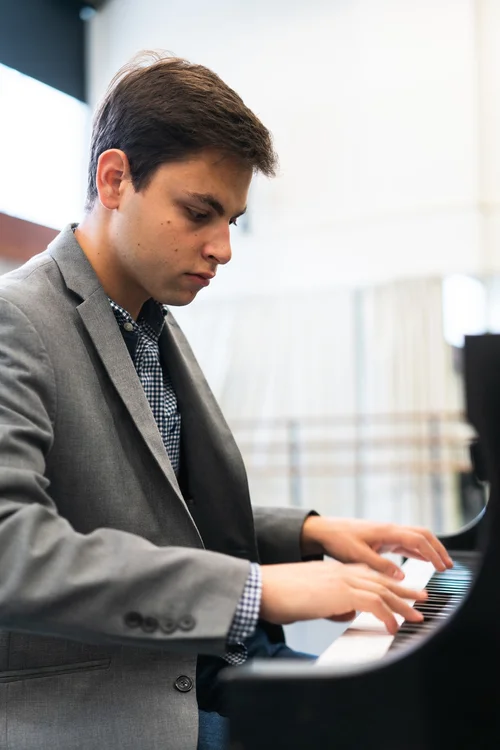
JOE BLOCK STORY
The Philadelphia Clef Club of Jazz is where I first learned how to play jazz. From improvisation to the blues, Coltrane to Ellington, the Clef Club taught me the building blocks of a genre of music that I now live and breathe. Thanks to the dedication and care from the incredible teaching staff, the Clef Club became a place where I could learn and create with my peers, without sacrificing my individuality. Today, some of my best friends and frequent musical collaborators I first met at the Clef Club years back. I am forever grateful for Mr. Hines and the entire organization for providing me with the skills, knowledge, performance opportunities, connections, love, and most importantly, the artistic community, that I will cherish and keep with me throughout my musical journey.
In addition to educating me as a jazz musician, the Clef Club also bestowed upon me the value of music education and mentorship, especially as arts education funding becomes increasingly scarce. Since graduating from the PCC program and moving to NYC, I have started teaching lessons in piano and arranging. One of my arranging students is current PCC guitarist Leo Steinriede who was recently awarded by Jazz at Lincoln Center the J. Douglas White Composition and Arranging Award. Leo is an extremely hard-working, talented, and inquisitive musician whose progress in the past year has nothing but amazed me. His big band arrangements are thoughtful and intelligent, vibrant and adventurous, and I look forward to the music he will create in the years to come.
It is no secret that the COVID-19 crisis has severely disrupted jazz scenes, communities, and economies around the world. Not to mention the thousands of performances that have been cancelled, colleges and conservatories were abruptly asked to transition to online learning in light of social distancing policies. My music classes at Juilliard are now being conducted virtually, and while this may at first seem incompatible, rest assured that the faculty have been very innovative and flexible in creating ways for us to learn and to feel inspired during this unprecedented time. Whether watching jazz documentaries together over Zoom, “playing together” via backing tracks or GarageBand, or simply discussing our favorite musicians or albums with each other, the communal and collaborative aspects of this music have not been completely suppressed by the pandemic.
Since my peers and I can no longer make music together in person in real time, individual practice has emerged as the primary avenue for study. I myself have been focusing on topics such as transcription, jazz history, solo piano, technique, composition, and arranging, all of which can be explored solo or with my peers, remotely. Furthermore, some of my friends and I put out some music not only for others to enjoy, but also to provide us with some solace and inspiration during these trying times. Earlier this year I was very fortunate to perform with Philadelphia native Leslie Odom, Jr. (you might know him more as Aaron Burr from Hamilton). One of the standards he sang was Jerome Kern’s “Look For the Silver Lining”, a song whose title helps us to combat the difficulties of this pandemic. Looking on the flip side of things, I am grateful that I now have more time to dig deeper into the lives and recordings of my musical heroes, to explore new artists that I have been meaning to delve into, and above all, to look inward towards how I can improve and grow as a person, friend, artist, pianist, and composer during this time of immobilization and uncertainty. This virus has forced us to retreat back to our nests and spend time with our families in close quarters. Let us look for the silver lining and use this time and space to connect with others, mend broken relationships, and overall become more empathetic and adaptable to the changing times. Allow others to inspire us, and, in turn, freely inspire others.
Nonetheless, the resilience and resourcefulness of musicians around the world has not only kept the music alive, but has helped to counter the fear and chaos that plague our world today. I encourage artists of any discipline to continue to work on your craft and dig deeper into the history and mythology of your artform. Show your music or art or dance or whatever you do to anyone who will listen or observe, whether that be just your families in your living room or a larger audience via online livestream. Any artistic messages of hope and love can help to transcend the struggles of social isolation. We must continue to use our creativity in this time of need to affect change in our communities. We must stay connected in our distanced existence.
This is by far an easy time for any musician, and although artistic inspiration may be lacking right now, I am confident that the ever-changing challenges that we are all facing today will ultimately make the music that much more powerful, more vibrant, and more grounded when we return to the bandstand.